Home  | Gift Shop  | Basket  | Order Tracking  | Multimedia  | Lesson Plans  | Forum  | Contact  | Help  | Partner Program  | Feedback  | Sign up for Newsletter  | Bookmark Us


Jellyfish Posters Jellyfish T-Shirts Jellyfish Magnets Jellyfish Gifts Jellyfish Pictures Jellyfish Videos Jellyfish Sounds Jellyfish Information Jellyfish Stock Footage Jellyfish Stock Photos  

  Jellyfish Movies

There are 34 video clip matches for 'Jellyfish'.
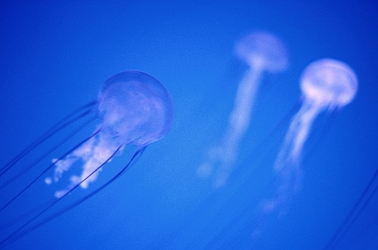
Jellyfish
Jellyfish
Photographer: Kim Steele
Copyright © 2003 JungleWalk.com and its licensors.
Rate this image and leave your feedback | Send as an e-card

You can customize this image and buy at it as a
Poster | Magnet | Tote Bag | Mousepad

More About Jellyfishes ...
Jellyfishes (also called jellies or sea jellies as they are not true fish) are animals that belong to Phylum Cnidaria, included in the class Scyphozoa. The name "jellyfish" is also sometimes used for the related classes of medusae (Hydrozoa) and box jellyfish (Cubozoa). Almost all jellyfish live in the seas and though they lack true organ structures they feature specialized tissues. The adult forms of these creatures are composed of 95-99% water. All species are found in each of the world's oceans, with a few species living in fresh water. Most jellyfish are passive drifters that feed on small fish and zooplankton that become caught in their tentacles. Jellyfish have an incomplete digestive system, meaning that the same orifice is used for both food intake and waste expulsion. They are Coelenterates which means "hollow gut", and are made up of a layer of epidermis, gastrodermis, and a thin jelly-like layer called mesoglea that separates the epidermis from the gastrodermis.


JellyfishThe jellyfish have two major body forms throughout their life. The first form is called the polyp stage and is characterized by a either a non-moving (sessile) stalk that catches food drifting by or a similar form that is free-floating. Their mouth and tentacles are located anteriorly, facing upwards. The second form looks like a saucer is called the medusa stage and is characterized by a round (radially symmetric) dome-shape body plan with food catching tentacles hanging down. It is this form which is most able to respond to and interact with its environment and is also the form most people are familiar with.

During the polyp stage, jellyfish do not have males or females, thus only asexual reproduction occurs. This happens in two ways: (1) budding, to produce other polyps; and (2) strobilating, to produce medusae. During budding, the egg or planula of the jellyfish attaches itself to a hard surface where it grows into its polyp form called scyphistoma. The scyphistoma then asexually produce many ephyra that look like round jagged disks and becomes a strobila. Then the ephyras detach themselves from the strobila and become mature free living medusae. At this stage is when they can reproduce sexually. The male will release their sperms into the water where the eggs will be fertilized.

Like all other cnidarians, jellyfish have stinging cells called cnidocytes which contains the stinging nematocysts on their tentacles. Whenever a prey comes in contact with a tentacle, hundreds to thousands of nematocysts fire one or another type of "hook and line" into the prey's direction. These stinging cells are thus able to latch onto the prey and the tentacles bring the prey item into their large "mouth" for digestion.These cells are activated by a simple but precise nervous system called a nerve net which is located in the epidermis of the jellyfish. Impulses to these nerve cells are sent from the nerve rings that have collected information from the environment of the jellyfish through the rhopalial lappet, which is located around the animal's body. Jellyfish also have "eyes" or ocelli that cannot form images, but are sensitive to light. Jellyfish do not have a specialized digestive system, excretory system, respiratory system, and circulatory system. They are able to digest with the help of the gastrodermis that lines the gastrovascular cavity, where nutrients from their food is absorbed. They do not need a respiratory system since their skin is thin enough that oxygen can easily diffuse in and out of their bodies. They do not have a brain, a heart, a central nervous system, a skeletal system and also no bones and no blood. Jellyfish move using a hydrostatic skeleton that controls the water pouch in their body to manipulate their movements.

Most jellyfish are not dangerous to humans but a few are highly toxic, such as the Cyanea capillata. Contrary to popular belief, the menacingly infamous Portuguese Man O' War (Physalia) isn't actually a jellyfish, but a colony of hydrozoan polyps.
Taxonmony
Phylum: Cnidaria
Class: Scyphozoa
Order:
Family:
Source: Wikipedia Read more about Jellyfishes
VIDEO CLIPS
Moon Jellyfish
2.050MB  MOV  View Movie
Tropical Marine Ecology Page (R. Hays Cummins, Miami University)
Close up shot of moon jellyfish
Jelly Fish
1.480MB  MOV  View Movie
Tropical Marine Ecology Page (R. Hays Cummins, Miami University)
A Small Box Jellyfish swims near the surface in Rice Bay
Jellyfish
0.520MB  MOV  View Movie
CNN
Nice clip of jelly fish. "Jellyfish have been around for millions of years. They're very well adapted to surviving in the oceans".
Jellyfish
0.700MB  MOV  View Movie
Moonjellyfish.com
Excerpt from the Sunset Marine Lab movie 'Under a liquid moon'
Jellyfish
1.090MB  MOV  View Movie
FINS : The Fish Information Service
Cassiopeia Andromeda jellyfish, swimming.
Purple Jellyfish
0.660MB  AVI  View Movie
California VideoDiver
Eighteen second clip of a purple jellyfish, Pelagia panopyra."A fleet of jellyfish pulsed into the boat anchorage from the open ocean"
Jellyfish
1.360MB  QT  View Movie
Ocean Collection for Kids
Jellyfish swimming
Jellyfish
Streaming  RM  View Movie
PBS
Watch this interesting narrative on jelly fishes and how it stings its prey! "But their elegant tentacles rippling out behind harbor a microscopic source of pain: cells that eject sharp, poison-tipped darts when they sense something nearby"
Jellyfish
Streaming  RM  View Movie
NASA Quest
Research on the effects of microgravity on jellyfish. Relevant information is shown after quarter of movie has streamed
Jellyfish
2.480MB  MOV  View Movie
Bioscience Explained
Marine Bioluminescence example - The deep sea jellyfish, Atolla wyvillei, seen with lights on and then with lights off.
Jellyfish
9.360MB  MOV  View Movie
University of Hawaii
Video clip of the giant sea jelly at the Hawaii Institute of Marine Biology
Jellyfish
3.570MB  MOV  View Movie
University of Hawaii
Video clip of the giant sea jelly at the Hawaii Institute of Marine Biology
Jellyfish
0.470MB  MOV  View Movie
Getty Images
close up of pulsing jellyfish
If you don't see the relevant video below, please follow this link and search for 83-2 in the search screen.
Jellyfish
2.340MB  MOV  View Movie
Getty Images
underwater jellyfish
If you don't see the relevant video below, please follow this link and search for 28-90 in the search screen.
Jellyfish
2.390MB  MOV  View Movie
Getty Images
yellow jellyfish swimming
If you don't see the relevant video below, please follow this link and search for 247-60 in the search screen.
Jellyfish
0.630MB  MOV  View Movie
Getty Images
jellyfish swimming
If you don't see the relevant video below, please follow this link and search for 29-71 in the search screen.
Jellyfish
2.480MB  MOV  View Movie
Getty Images
jellyfish swimming
If you don't see the relevant video below, please follow this link and search for 29-75 in the search screen.
Stalked Jellyfish
16.800MB  MOV  View Movie
RaceRocks.com
The Stalked Jellyfish
Jellyfish
12.530MB  MOV  View Movie
RaceRocks.com
Jellyfish swimming in the waters of Race Rocks.
Common jellyfish
MOV  View Movie
Arkive.org
Nice selection of Common jellyfish video clips available in various formats
Jellyfish
WMV  View Movie
Neptune's Garden Productions
Jellyfish
Jellyfish
MOV  View Movie
Dive Site Videos
Jellyfish displaying bioluminescence
Jellyfish
0.400MB  MPG  View Movie
University of Aberdeen Zoology Museum
Clip of Jellyfish
Jellyfish
Streaming  RAM  View Movie
PBS - Nova
Jellyfish pump their graceful bodies through Cocos waters.
Jellyfish
0.320MB  MPG  View Movie
jellitot.com
Jellyfish - Farne Islands
Stalked Jellyfish
9.690MB  MPG  View Movie
Marine Life of the Northeast Pacific Ocean
This is a stalked jellyfish swaying in the surge on a piece of kelp
Jellyfish
1.330MB  MPG  View Movie
Marine Life of the Northeast Pacific Ocean
Clip of a jellyfish swimming
Jellyfish
5.870MB  MPG  View Movie
Marine Life of the Northeast Pacific Ocean
Clip of a jellyfish swimming
Jellyfish
3.790MB  MPG  View Movie
Marine Life of the Northeast Pacific Ocean
Clip of a jellyfish swimming
Sea Nettle
0.570MB  MOV  View Movie
Creatas
Sea nettle swimming
Jellyfish
0.820MB  MOV  View Movie
Creatas
Jellyfish swimming
Jellyfish
0.470MB  MOV  View Movie
Creatas
Jellyfish beside a plant
Jellyfish
2.390MB  MOV  View Movie
Rudewater
Jellyfish
Jellyfish
0.460MB  MPG  View Movie
Rutgers Coastal Ocean Observation Lab
Jellyfish clip


Home   Basket   My Account   About
©2002-2006 Netrikon Designs. All rights reserved.
Visit JungleWalk.com to learn more about animals!